Guide
How to play conversation cards
There isn’t much to it: draw a card, answer it, listen. Here are the simple rules, the house rules that help, and setups for every kind of group.
Kumustahan is a bilingual conversation card app: 1,200 questions in English and Filipino across 7 decks, with a short reflection on the back of every card.
Step by step
How a round goes
-
01
Pick a deck
Choose the deck that fits the room: Icebreakers or Getting to know for new people, Barkada for friends, Couples for two, Reflect for yourself. You can mix a few.
-
02
Set the depth
Decide how deep tonight goes. In Kumustahan, Keep it light deals only playful cards, Open up adds personal ones, and Go deeper deals everything.
-
03
Take turns drawing
One person draws a card, reads it out loud and answers first, or names who answers. Add players’ names in the app and each card shows whose turn it is.
-
04
Answer, or pass
Answer as honestly as feels right tonight. Anyone can pass any card, no reason needed.
-
05
Listen, then follow up
While someone answers, everyone else listens: no phones, no fixing. One follow-up question is welcome.
-
06
Flip and pass it on
Flip the card for the short reflection on the back, then hand the phone to the next person. Stop when the night feels done, not when the deck runs out.
What are conversation cards?
Conversation cards are decks of questions written to be asked out loud, in a pair or a group. Unlike trivia or a party game, there are no right answers and nobody keeps score. A good card is short, clear and specific enough that people answer with a story instead of a word.
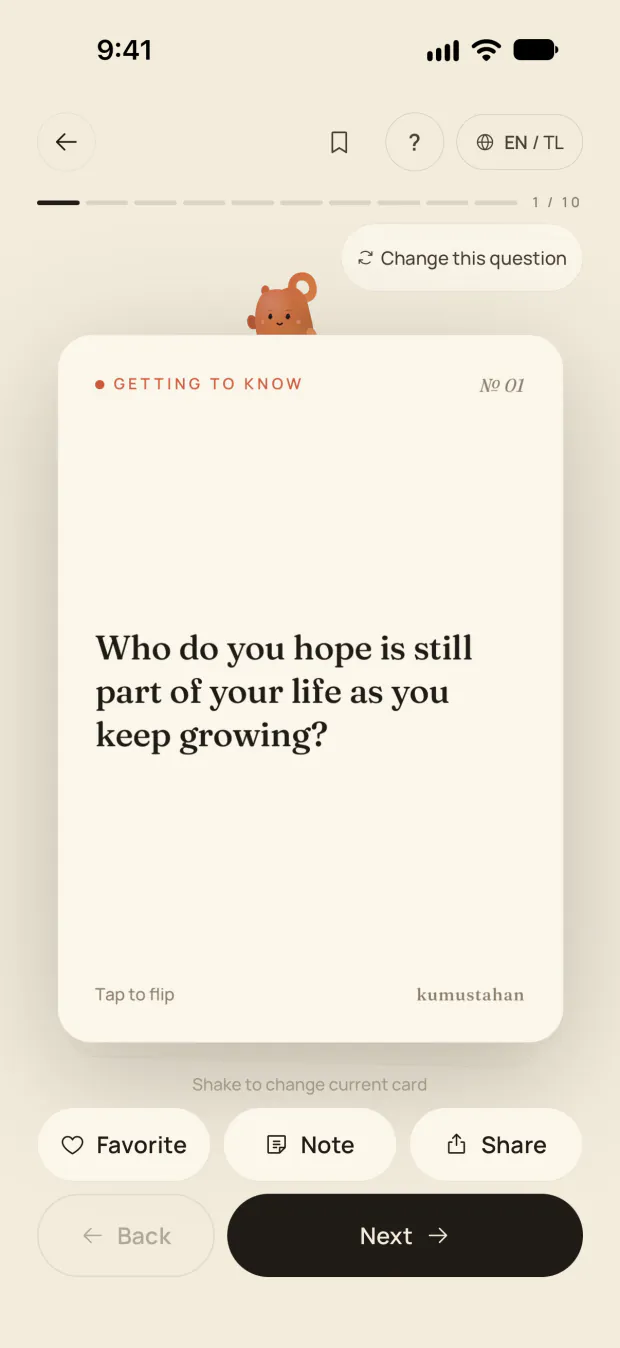
Kumustahan puts them on your phone: 1,200 cards across 7 decks, each with a question on the front and a short reflection on the back, in English and Filipino. You pass one phone around the table instead of a box of cards.
House rules that make it work
Say these out loud before the first card. It takes ten seconds and changes the whole night.
- Anyone can pass. No reason needed, and no teasing after.
- Answer at your own depth. A short answer is still an answer.
- Phones down, except the one with the cards on it.
- Listen to understand, not to reply. No fixing and no advice unless someone asks for it.
- One follow-up is welcome. “What happened next?” is a good one.
- What’s said at the table stays at the table.
- The reader can go first, to show how long an answer can be.
Setups for every kind of group
The rules stay the same. What changes is the deck, the depth and how you pass the cards around.
- Couples. Play somewhere unhurried: after ordering on a date, or on the couch with the TV off. Take turns asking, start light, and leave the harder cards for when you both have room. The Couples Edition is written for exactly this.
- Barkada. Mix Barkada with Just for fun, pass the phone around the circle, and let the group react before the next card. With a big group, read each card aloud and let anyone answer.
- Family. Play at the table after a meal, with every generation answering. Light cards from Getting to know and Just for fun work across ages, and lolo and lola often have the stories nobody has heard.
- Lifegroup. Open with one light card, then two or three from Lifegroup & Faith, with everyone answering each. Close by praying for what came up.
- Team or work. Use Icebreakers on Keep it light at the start of a meeting: one card, everyone answers in a sentence. Five minutes, then get to work.
- Classroom or retreat. In a big room, split into circles of four to six with one phone each. At a retreat, follow a talk with a few Reflect cards and some quiet time to write.
- Solo. Draw one card from Reflect before bed, write your answer as a note, then flip the card. It’s journaling with a starting line.
Tips for whoever’s hosting
You don’t need to be a facilitator to host a good night. A few small moves do most of the work.
- Start lighter than you think. Deep questions land better after people have laughed together.
- Answer the first card yourself, honestly and briefly. People copy the host.
- Watch the room, not the deck. If a card lands heavy, thank the person and move to something lighter.
- Let a silence sit for a few seconds. People are thinking, not stuck.
- Make passing feel normal. Pass once yourself if nobody has yet.
- Stop while it’s good. End on a light card and save the rest for next time.
Playing with the Kumustahan app
Pick your decks, then set the tone: how many cards and how deep. Add who’s playing if you like. Salo, the dealer, shuffles and deals. Its name comes from kasalo, the one who shares your table.
Tap a card to flip it for the reflection, swipe for the next one, or change a card that doesn’t fit the moment. Keep the good ones as favorites, write a note in the margin, and the app remembers which cards you’ve played, so next time you get new ones.
Every card has English and Filipino, and you can switch languages mid-card. It works offline with no account, and if you stop halfway, the session waits for you on Home.
Try it here
Draw a few cards.
Real cards from the free decks. Tap one to flip it for the reflection on the back.
-
From Icebreakers →Icebreakers№ 11
For a good hangout, what matters most: tasty food, a comfy place, or good conversation?
Sa bonding, ano ang pinakamahalaga: masarap na pagkain, komportableng lugar, o masayang kuwentuhan?
Tap to flipkumustahanA noteImagine a hangout with your top choice and nothing fancy. Where would it happen?
Isipin ang simpleng bonding na mayroon ng pinili mo. Saan ito mangyayari?
Tap to returnkumustahan -
From Barkada →Barkada№ 02
Recall a moment when talking to a new friend started to feel easy.
Kailan ka nagsimulang maging komportable sa pakikipagkuwentuhan sa bago mong friend?
Tap to flipkumustahanA noteRemember the first thing you no longer felt shy about saying.
Balikan ang unang bagay na hindi ka na nahiyang sabihin.
Tap to returnkumustahan -
From Just for fun →Just for fun№ 29
Finish this: our barkada or family always laughs when ___.
Tapusin yung line: Laging nauuwi sa tawanan kapag ___.
Tap to flipkumustahanA noteShared laughter becomes part of a group's language. Sometimes one unfinished sentence is enough to bring everyone back there.
Yung shared laughter, nagiging sariling language ng group. Minsan isang bitin na sentence lang, gets na agad.
Tap to returnkumustahan -
From Getting to know →Getting to know№ 39
Tell us about a friend who made you feel like you belonged.
Ikuwento yung friend na nagparamdam sa'yo na belong ka.
Tap to flipkumustahanA noteInclusion can happen through one seat saved, one question asked, or one person making room on purpose.
Minsan isang upuang tinabi, isang tanong, o isang taong sinadyang magtabi ng space ang nagpaparamdam na kasama ka.
Tap to returnkumustahan -
From Getting to know →Getting to know№ 55
If a friend said you have changed in a good way, what change would you hope they noticed?
Kung sabihin ng friend mo na nagbago ka in a good way, anong change ang sana napansin nila?
Tap to flipkumustahanA noteThe change you hope someone notices may point to what you have been quietly practicing.
Yung change na sana mapansin nila baka yun yung tahimik mong pinapractice nitong season.
Tap to returnkumustahan
FAQ
Frequently asked questions
What are the rules of a conversation card game?
Take turns drawing a card, read it aloud, answer it or pass, and listen while the others answer. Most groups add two house rules: anyone can pass, and what’s shared at the table stays there.
How many people do you need to play conversation cards?
One is enough, since the cards work as journal prompts on your own. Two to eight people is a comfortable circle; bigger groups can split into smaller ones with a phone each.
How long does a game of conversation cards take?
As long as you like. Ten cards usually fill thirty minutes to an hour when people tell stories, and an icebreaker round can take five minutes.
What if someone doesn’t want to answer a card?
They pass, no explanation needed, and the game moves on. In Kumustahan you can also change the card for another one.
Do we need physical cards?
No. Kumustahan puts the decks on your phone, so you pass the phone instead of a box. It works offline and needs no account.
Can players answer in different languages?
Yes. Every Kumustahan card has English and Filipino, so one person can read it in Tagalog and another can answer in English. More in Tagalog conversation starters.
Can conversation cards get too personal?
Only if the depth doesn’t match the room. Start light, let anyone pass, and in Kumustahan choose Keep it light or Open up in setup so the deeper cards stay out of the deal.

Bring a better question to the table.
Free on iPhone and Android. 420 cards free, no account, works offline.